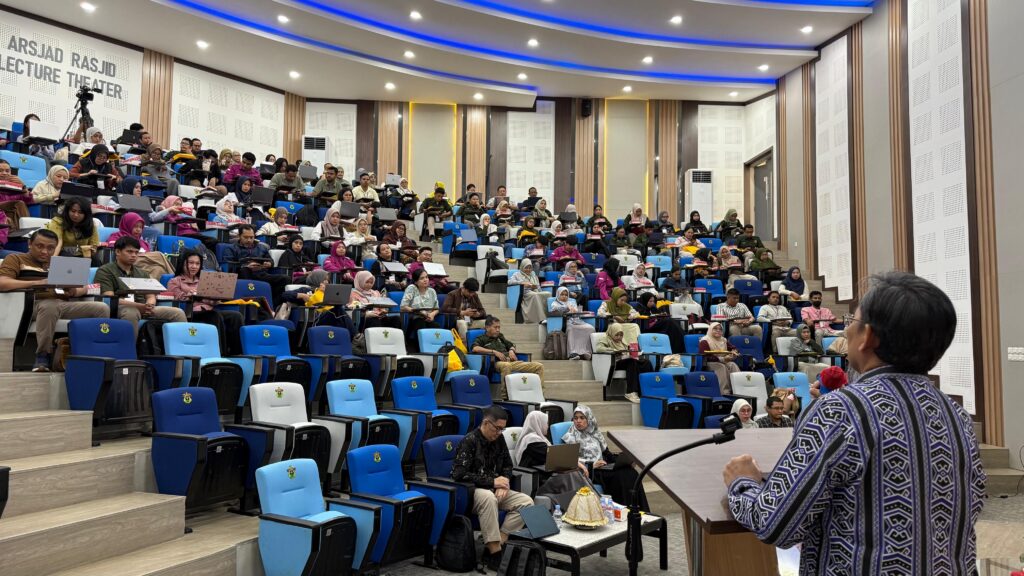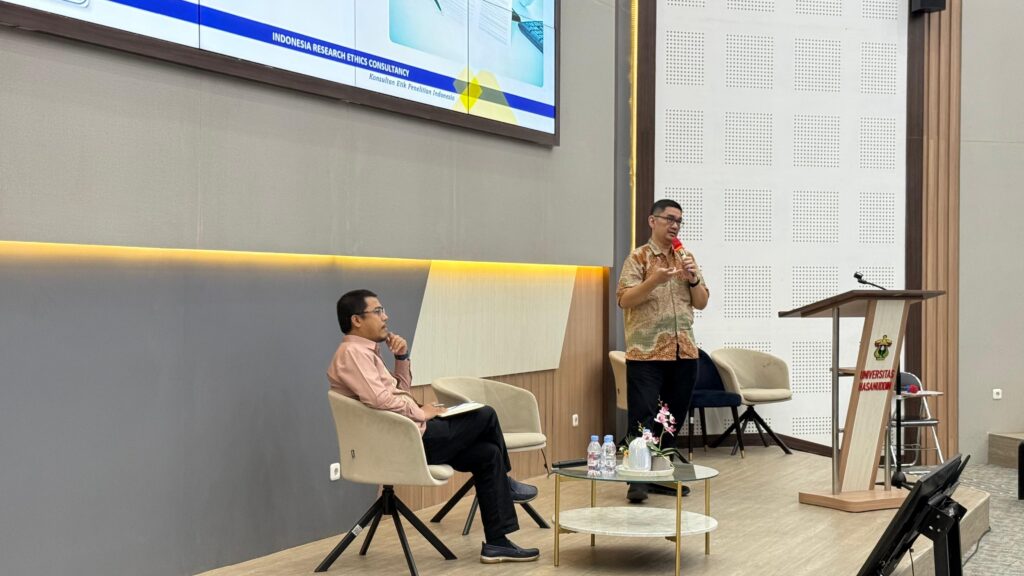
The Health Research Ethics Committee (KEPK) of the Faculty of Nursing, Universitas Hasanuddin (FKep Unhas), held a two-day Basic Health Research Ethics Training from Thursday to Friday, November 19–20, 2026. The event was conducted in a hybrid format, taking place in person at the Arsjad Rasjid Lecture Theatre, Universitas Hasanuddin, and virtually via Zoom Meeting.
The training aimed to enhance foundational competencies in health research ethics and was attended by 147 participants from various academic and professional backgrounds, including lecturers, undergraduate and postgraduate (master’s and doctoral) students, researchers, ethics reviewers, and healthcare professionals.
The program featured three expert speakers in the field of research ethics: Harnawan Rizky, S.Si., MOHRE (from the Forum of Indonesia Recognized Research Ethics Committee/FIRREC), as well as Dr. Takdir Tahir, S.Kep., Ns., M.Kes, and Dr. Andriani, S.Kep., Ns., M.Kes, both from the Faculty of Nursing, Universitas Hasanuddin.
In his opening remarks, the Vice Dean for Partnerships, Research, Innovation, and Alumni, Dr. Takdir Tahir, S.Kep., Ns., M.Kes, emphasized that the core purpose of the ethical review process goes beyond merely fulfilling administrative requirements; it is fundamentally about ensuring the safety and rights of research participants.
“The highest philosophy within an ethics committee is the protection of research subjects. Researchers are expected to avoid any actions that could cause harm or create problems for the individuals participating in their research,” he stated.
Throughout the two-day event, participants were provided with a comprehensive range of training materials. The material covers governance and quality enhancement, integrity practices, ethical principles and guidelines for research, an introduction to the ethical review process for research protocols, risk-benefit considerations and the inclusion of vulnerable participants, the Informed Consent process, as well as ethical standards for research involving Stored Biological Materials (SBM) and secondary data. In addition to the presentation of course material, participants are also guided to explore the practical application of ethics through introductory sessions and case study discussions focused on health research.
By completing this training, participants are expected to gain the proficiency to develop and review research protocols in accordance with established ethical standards, while becoming more attuned to minimizing risks for research participants. Through this initiative, the Health Research Ethics Committee (KEPK) of the Faculty of Nursing at Hasanuddin University (Unhas) reaffirms its commitment to fostering a research culture that upholds academic integrity and prioritizes the protection of human subjects in health research. (*/la)